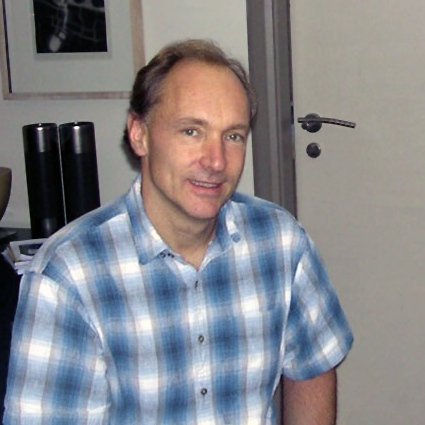
Tim Berners-Lee was born in 1955 in London to parents who worked on programming one of the earliest commercial computers, instilling in him an early passion for computing. He studied physics at Oxford University, and in 1980 joined CERN, the European laboratory for particle physics in Switzerland, as a software contractor, where he noticed how difficult it was for thousands of researchers using different computer systems and software to share information.
In 1989 Berners-Lee proposed a system for linking documents across the internet using «hyperlinks,» and during 1990 developed the three core components of what he called the «World Wide Web»: HyperText Markup Language (HTML), HyperText Transfer Protocol (HTTP), and Uniform Resource Locators (URL). He also wrote the world's first web browser and server, and made the code freely available to everyone with no fees or patents — a decision that changed the course of technological history.
Scientific Legacy
Berners-Lee founded the World Wide Web Consortium (W3C) in 1994 to establish open standards ensuring the web works consistently across different devices and software. He was knighted by Queen Elizabeth II in 2004 and awarded the 2016 Turing Award, the highest honor in computer science. Through the World Wide Web Foundation, he continues to advocate for an open internet accessible to everyone, and to challenge corporate monopolies over personal data.