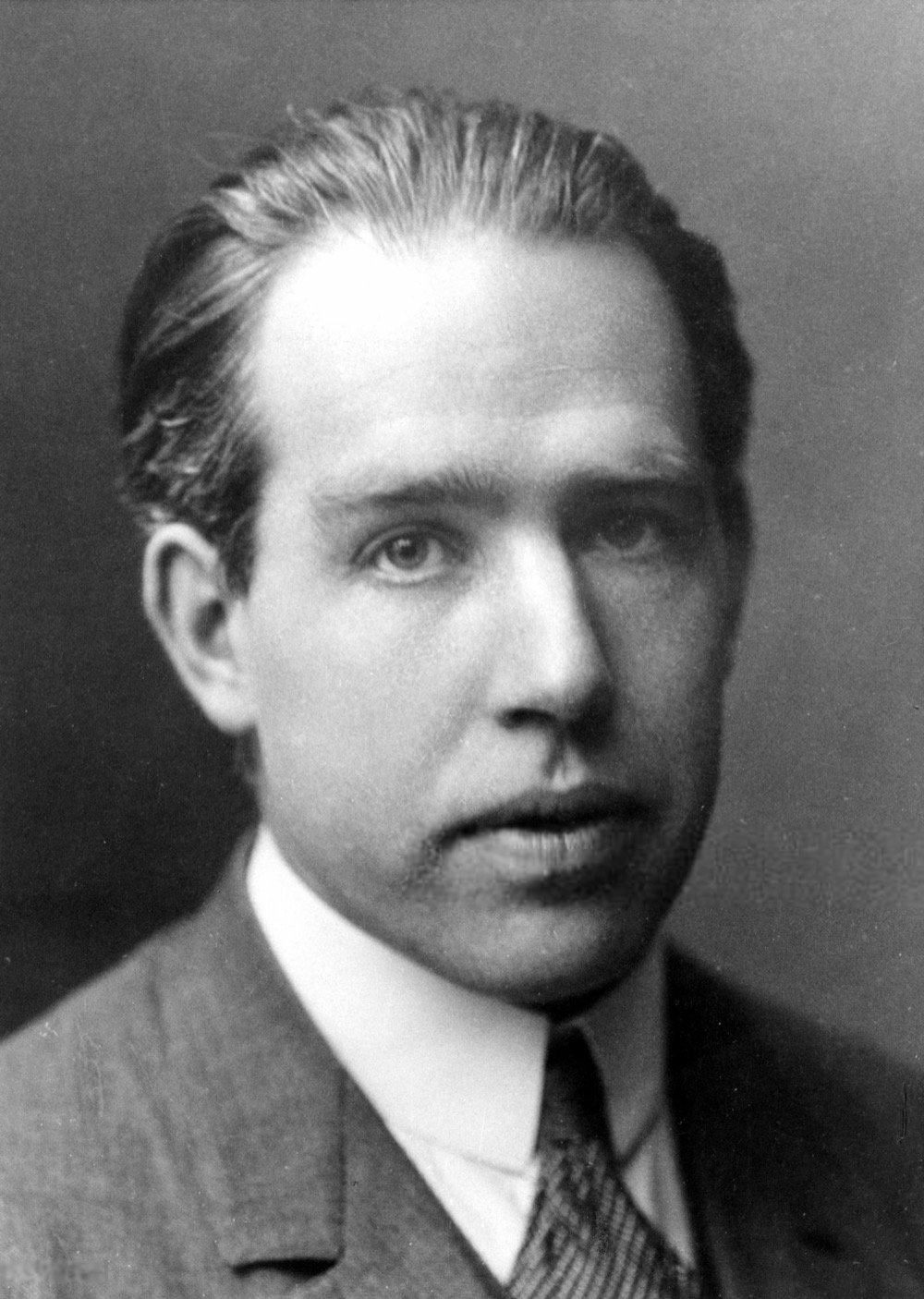
Niels Bohr was born in 1885 in Copenhagen to a distinguished academic family, studied physics at the University of Copenhagen, and then moved to England to work with Ernest Rutherford, the discoverer of the atomic nucleus. Bohr noticed that Rutherford's atomic model, with electrons orbiting a positively charged nucleus, could not be stable under classical physics, since electrons should lose energy and spiral into the nucleus within fractions of a second.
In 1913 Bohr proposed a revolutionary model in which electrons could only occupy specific energy levels, or «allowed orbits,» moving between them by absorbing or emitting discrete quanta of energy as light. The model precisely explained the light spectra emitted by hydrogen atoms and laid the foundation of modern quantum mechanics. He was awarded the 1922 Nobel Prize in Physics for this achievement.
Scientific Legacy
Bohr founded the Institute for Theoretical Physics in Copenhagen in 1921, which became a global hub attracting leading twentieth-century physicists such as Heisenberg and Pauli. He formulated the «principle of complementarity,» explaining how subatomic particles could behave as both waves and particles depending on how they are measured — a central idea in what became known as the «Copenhagen interpretation» of quantum mechanics. During World War II he fled Nazi-occupied Denmark and later contributed to the Manhattan Project, before advocating for the peaceful use of atomic energy and open international scientific cooperation.