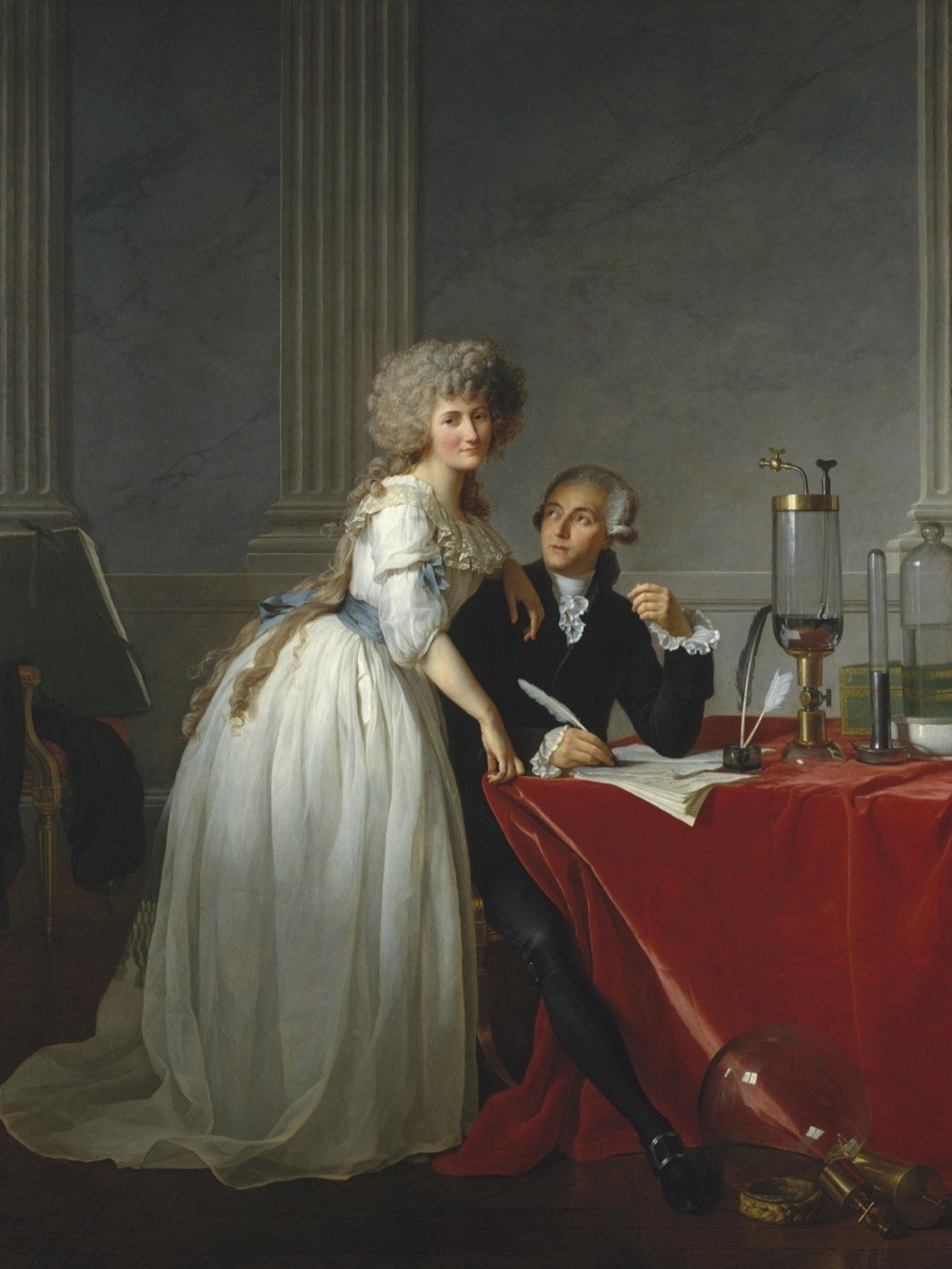
Antoine Lavoisier was born in 1743 in Paris to a wealthy family, and studied law before turning to natural science, particularly chemistry and geology. He worked for the French tax collection agency alongside his scientific research, which funded an advanced laboratory equipped with precise balances that became the foundation of his rigorous, quantitative scientific method.
Lavoisier challenged the prevailing phlogiston theory, which explained combustion by assuming a fictitious substance released from burning objects. Through careful experiments measuring the mass of substances before and after combustion in sealed vessels, he showed that combustion was actually a chemical reaction with a gas in the air he named «oxygen,» and that total mass remained constant throughout the reaction. This established the law of conservation of mass, one of the most fundamental laws in chemistry and physics.
Scientific Legacy
Lavoisier named the elements oxygen and hydrogen, and together with colleagues developed a systematic chemical nomenclature that still underlies modern chemical terminology, published in his landmark 1789 textbook «Traité élémentaire de chimie.» During the French Revolution, he was arrested for his earlier work with the royal tax collection agency and guillotined in 1794 at age 50, a loss often described as one of science's great tragedies of the revolutionary era.