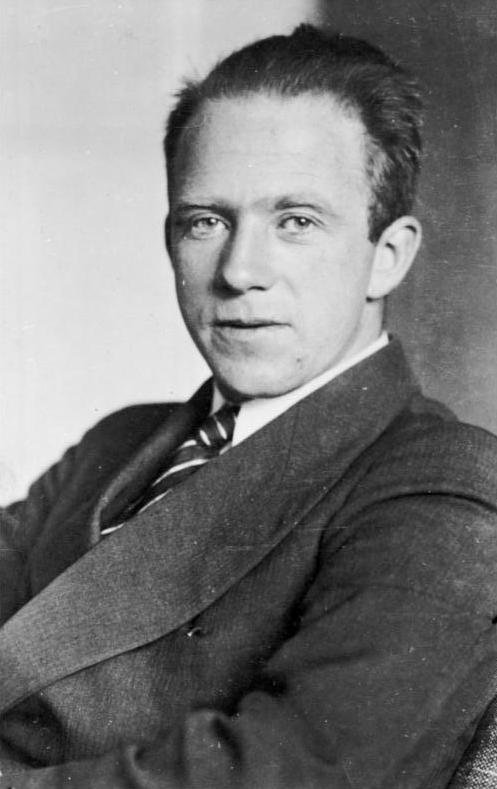
Werner Heisenberg was born in 1901 in Würzburg, Germany, and studied physics at the University of Munich under Arnold Sommerfeld before continuing his training in Göttingen and Copenhagen alongside Niels Bohr. In 1925, at just twenty-four, he developed a new mathematical formulation known as «matrix mechanics», the first internally consistent mathematical framework for modern quantum mechanics.
In 1927 Heisenberg formulated the «uncertainty principle», which states that it is fundamentally impossible to know both the position and momentum of a subatomic particle with perfect precision simultaneously. This was not a limitation of measuring instruments but an intrinsic property of nature itself, overturning classical physics' assumptions about determinism.
Scientific Legacy
Heisenberg was awarded the 1932 Nobel Prize in Physics for his foundational contributions to quantum mechanics. During World War II he led Germany's nuclear research program, a role that remains the subject of historical debate over how seriously the effort pursued a nuclear weapon. After the war he continued theoretical research until his death in 1976, leaving the uncertainty principle as a cornerstone of modern physics.