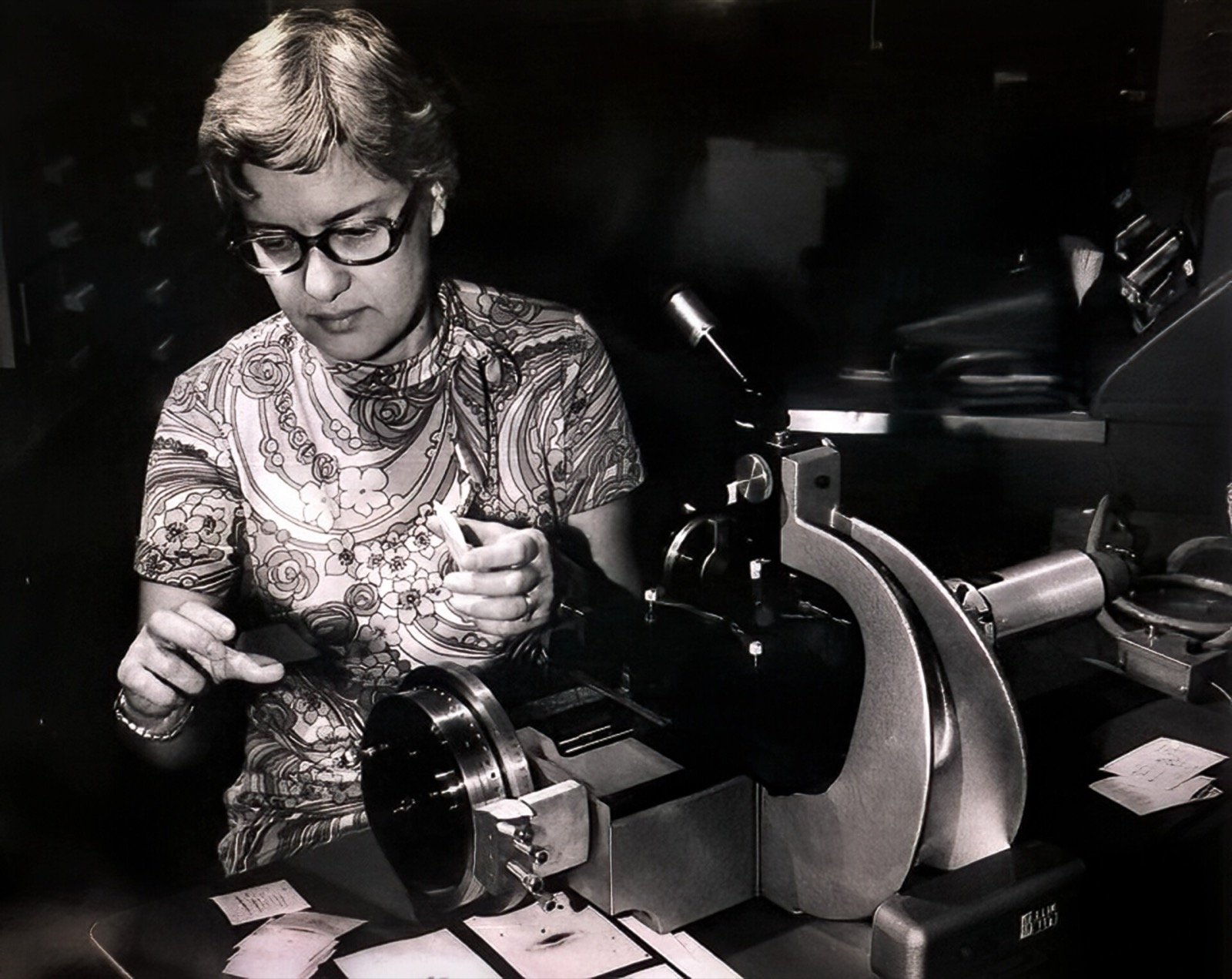
Vera Rubin was born in 1928 in Philadelphia, Pennsylvania, and fell in love with astronomy as a child watching the stars from her bedroom window. She was rejected by Princeton, which at the time excluded women from its graduate astronomy program, and completed her studies at Cornell University and then Georgetown University, earning her PhD in 1954.
In the 1960s and 1970s, Rubin worked with astronomer Kent Ford measuring the rotation speeds of stars in spiral galaxies, particularly Andromeda. She found that stars in the outer regions of galaxies rotated at nearly the same speed as stars near the center, directly contradicting what gravity would predict based on visible matter alone.
Scientific Legacy
Rubin explained this phenomenon as evidence of a vast, unseen mass surrounding galaxies, whose gravity influenced stellar motion — what became known as «dark matter». Her research provided the strongest observational evidence at the time for this mysterious substance, now estimated to make up about 85 percent of the universe's matter. Despite the significance of her discovery, Rubin never won a Nobel Prize, an omission widely noted, but she received other prestigious scientific honors, and the Vera C. Rubin Observatory in Chile was named after her. She died in 2016.