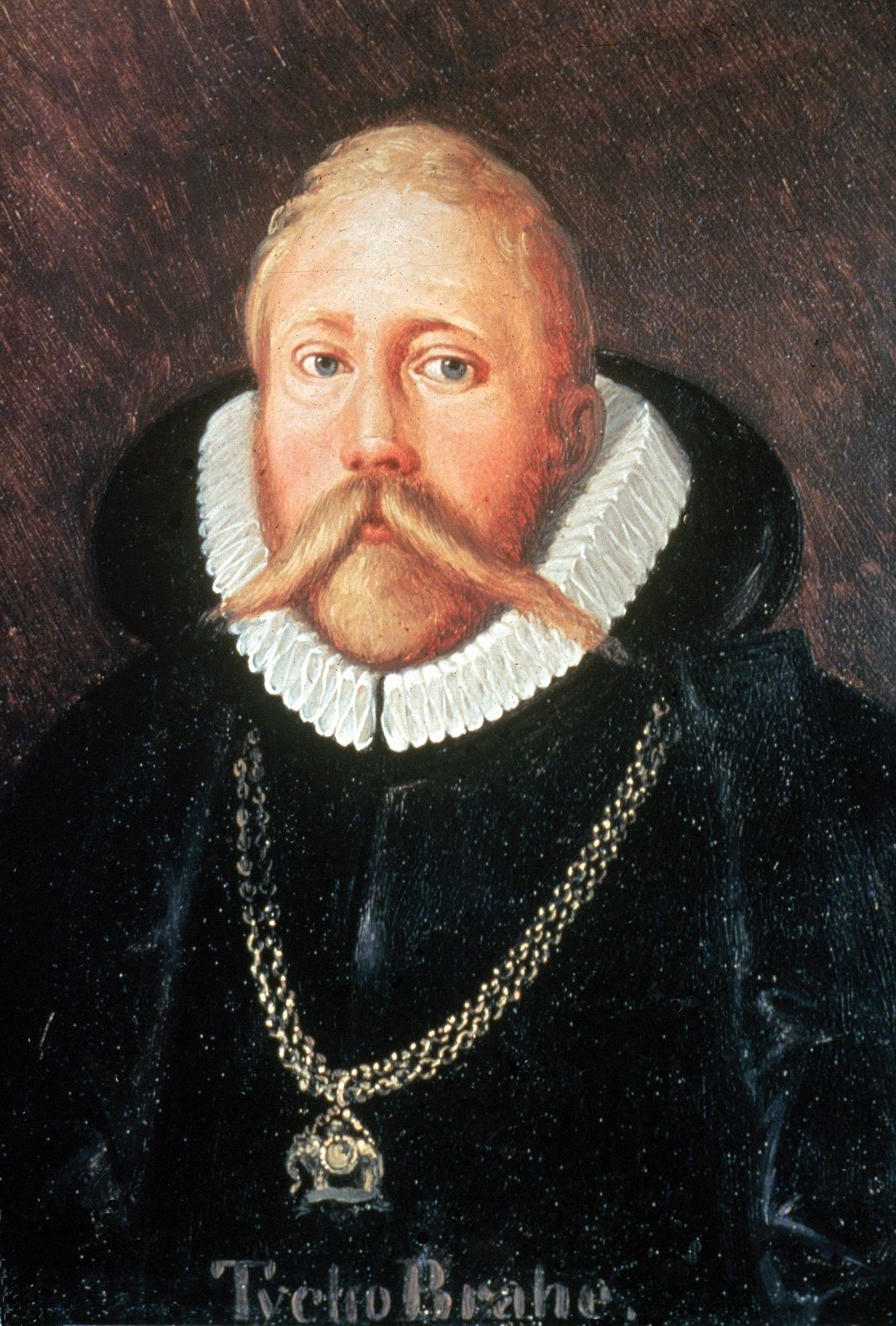
Tycho Brahe was born in 1546 in Knudstrup, Denmark, into a noble family, and his interest in astronomy was sparked by a solar eclipse he witnessed as a boy. He gained the support of King Frederick II of Denmark, who granted him the entire island of Hven to build a massive observatory called «Uraniborg», equipped with the finest astronomical instruments available before the telescope's invention.
Brahe spent decades observing the positions of stars and planets with unprecedented precision, recording exceptionally accurate data on Mars's orbit in particular. He rejected the Copernican model of a fully Sun-centered system, proposing his own model combining a stationary Earth with a partial heliocentric arrangement, but the true value of his work lay in the precision of his observations rather than his theoretical model.
Scientific Legacy
Late in life, Brahe took on Johannes Kepler as an assistant in Prague. After Brahe's death in 1601, Kepler inherited his vast archive of precise observations, later using it to discover that Mars's orbit was elliptical — the discovery that founded the laws of planetary motion. Despite lacking a telescope, Brahe's observations are considered the most precise in history before the modern era.