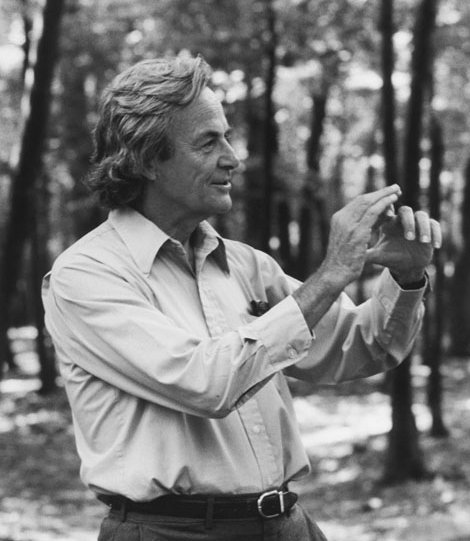
Richard Feynman was born in 1918 in New York and studied physics at MIT and then Princeton University. In his twenties he joined the Manhattan Project to develop the atomic bomb at Los Alamos, an experience that shaped part of his early scientific career.
After the war, in the late 1940s, Feynman developed a new formulation of quantum electrodynamics (QED), the theory describing how light and matter interact at the quantum level. He devised a visual tool now known as «Feynman diagrams», which simplified calculations of subatomic particle interactions and became a standard language in theoretical physics.
Scientific Legacy
Feynman was awarded the 1965 Nobel Prize in Physics, shared with Julian Schwinger and Sin-Itiro Tomonaga. He also became known for his undergraduate physics lectures, compiled into «The Feynman Lectures on Physics», and for his role investigating the 1986 Space Shuttle Challenger disaster, where he publicly demonstrated that the cause was rubber O-rings stiffening in cold temperatures. He died in 1988, leaving a wide-reaching scientific and educational legacy.