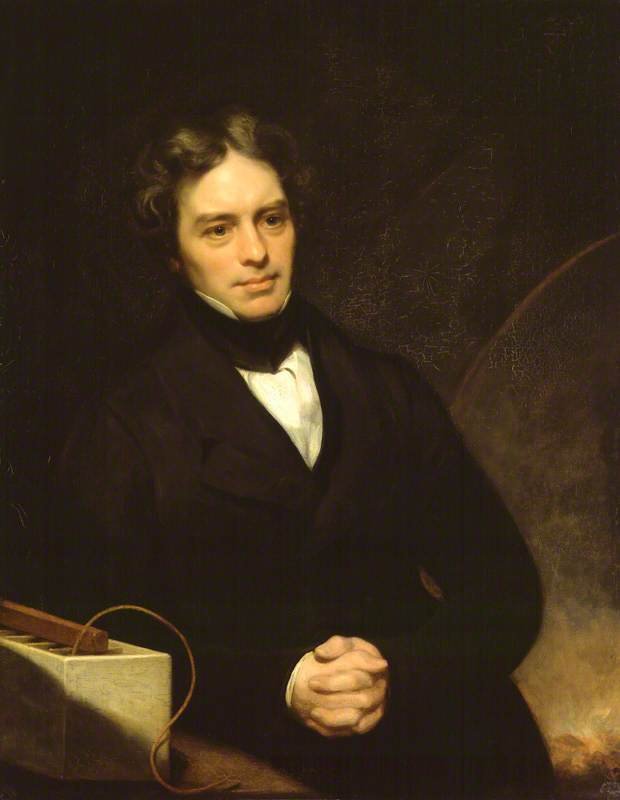
Michael Faraday was born in 1791 in Newington Butts, London, into a poor family that could not afford him a formal education. As a boy he worked as an apprentice bookbinder, which gave him access to scientific books and sparked a deep passion for chemistry and physics that led him to become an assistant to the famous chemist Humphry Davy.
In 1831, Faraday made his most important discovery: electromagnetic induction, demonstrating that a changing magnetic field can generate an electric current—the principle underlying the electric generators and motors that power the modern world. He also formulated the laws of electrolysis that bear his name and conceived the “Faraday cage” for shielding electric fields.
A scientist without formal academic training
Despite lacking advanced mathematical training, Faraday possessed an extraordinary gift for experimentation and physical intuition, leaving behind a vast legacy in electromagnetism and chemistry, including his discovery of the compound benzene. He is regarded today as one of the greatest experimentalists in the history of science.
- Discovered electromagnetic induction in 1831
- Formulated the laws of electrolysis
- Conceived the Faraday cage
- Discovered the chemical compound benzene