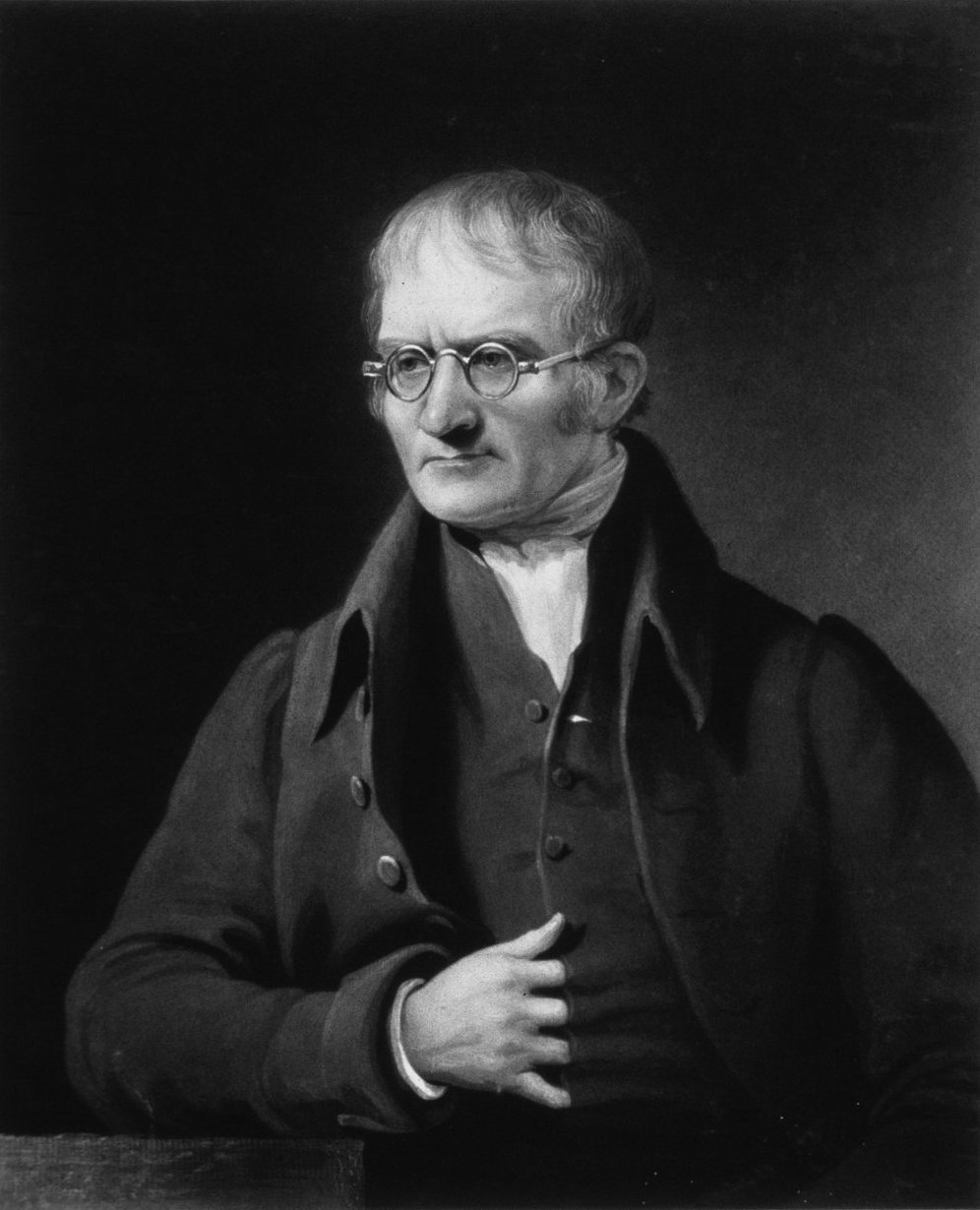
John Dalton was born in 1766 in Eaglesfield, England, into a modest Quaker family, and was largely self-taught, beginning to teach at just twelve years old. He took an early interest in meteorology, recording daily weather observations for over fifty consecutive years, which led him to study the properties of gases and the composition of atmospheric air.
Between 1803 and 1808 Dalton developed the modern «atomic theory», proposing that each chemical element consists of identical atoms of a characteristic mass, and that atoms combine in simple whole-number ratios to form chemical compounds. He published these ideas in his 1808 book «A New System of Chemical Philosophy», accompanied by the first table of relative atomic masses then known.
Scientific Legacy
Dalton's atomic theory laid the foundation upon which all of modern chemistry was built, from the laws of definite and multiple proportions to understanding chemical reactions as rearrangements of atoms. Dalton also studied color blindness, a condition he himself experienced, becoming the first to describe it scientifically with precision — the condition was later named «Daltonism» in his honor. He died in 1844.