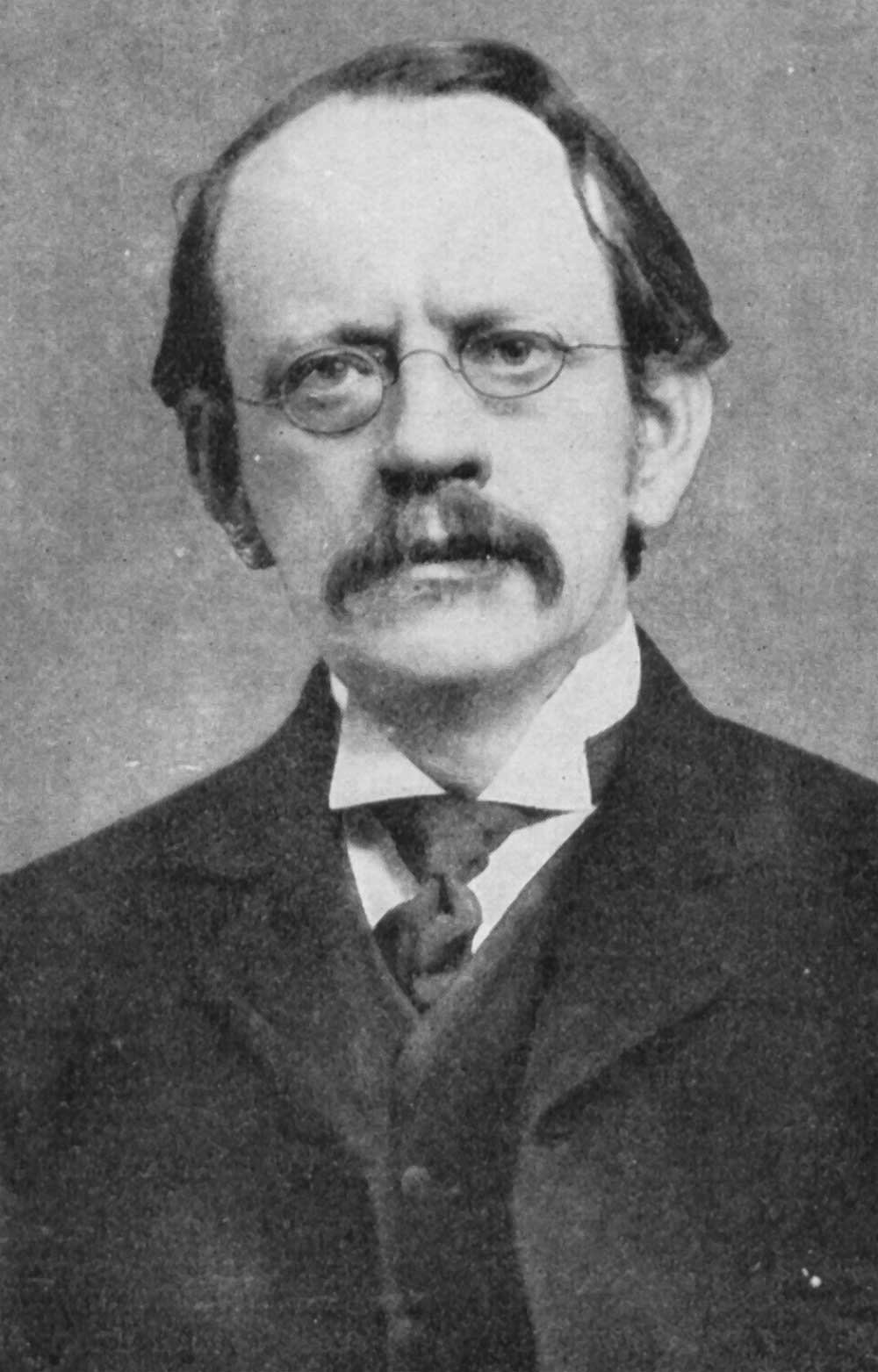
Joseph John Thomson was born in 1856 near Manchester, England, and studied at Cambridge University, later becoming director of the famous Cavendish Laboratory in 1884. His research focused on the mysterious «cathode rays» emitted from evacuated tubes when an electric current passed through them.
In 1897 Thomson conducted a series of precise experiments proving that cathode rays consisted of negatively charged particles roughly a thousand times lighter than the lightest known atom, hydrogen. He named this particle the «electron», shattering the millennia-old belief that the atom was the smallest, indivisible unit of matter.
Scientific Legacy
Thomson proposed an atomic model known as the «plum pudding model», picturing the atom as a positively charged mass studded with negative electrons, later superseded by Rutherford's model. Thomson was awarded the 1906 Nobel Prize in Physics, and at the Cavendish Laboratory mentored generations of scientists, seven of whom went on to win Nobel Prizes themselves, including his own son George Paget Thomson. He died in 1940.