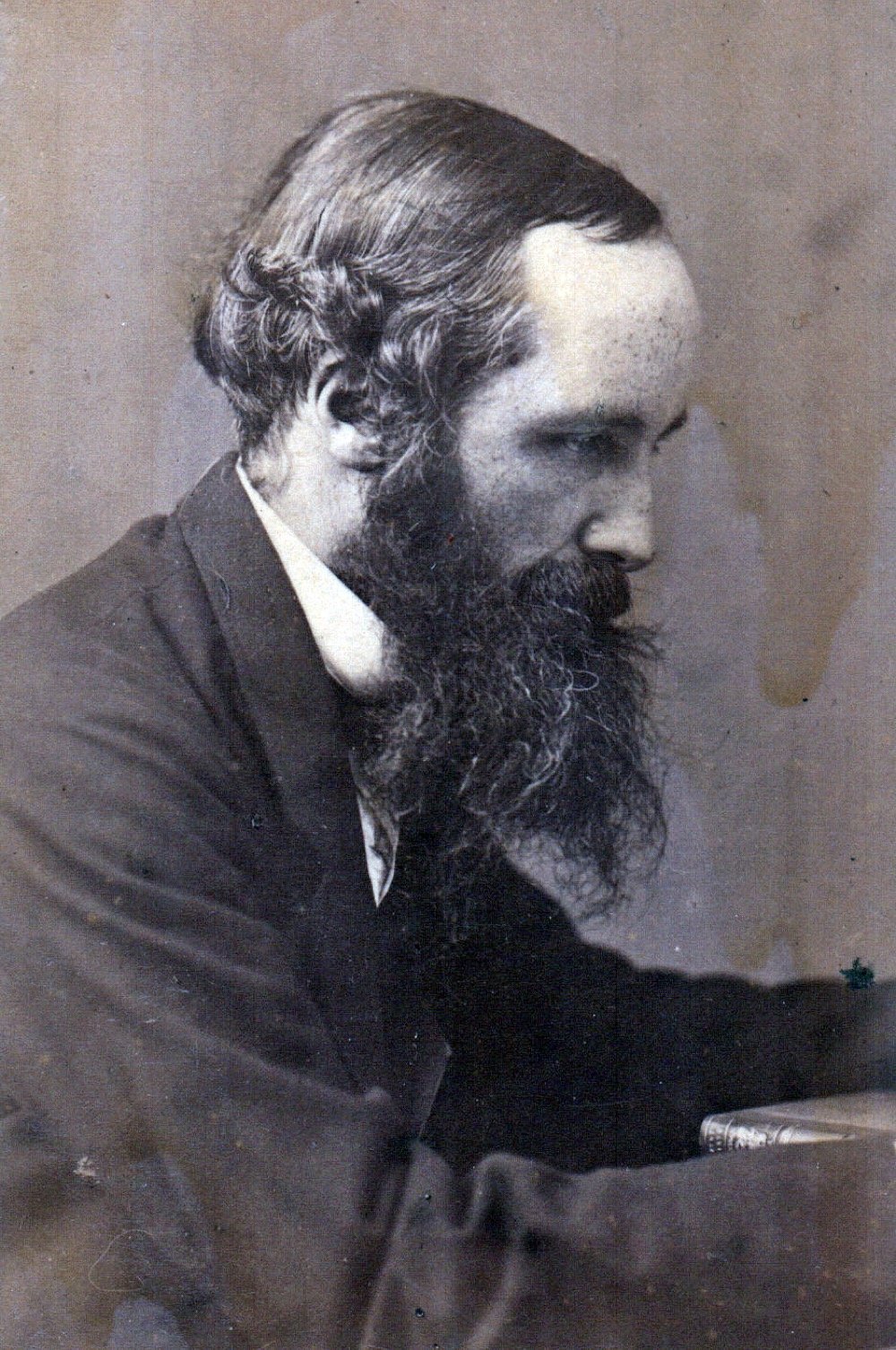
James Clerk Maxwell was born in 1831 in Edinburgh, Scotland, and showed early brilliance, publishing his first scientific paper at age sixteen. He studied at the universities of Edinburgh and Cambridge, moving through several academic posts before becoming the first director of the famous Cavendish Laboratory at Cambridge in 1871, which later became one of the world's leading centers of physics research.
Maxwell is best known for formulating a set of four mathematical equations, now known as Maxwell's equations, which unified electricity, magnetism, and light within a single theoretical framework. These equations showed that changing electric and magnetic fields propagate through space as waves, and that the speed of these waves matched the experimentally measured speed of light, leading Maxwell to conclude that light itself is a form of electromagnetic wave.
Scientific Legacy
Alongside his work on electromagnetism, Maxwell developed the kinetic theory of gases, and together with Ludwig Boltzmann formulated the Maxwell-Boltzmann distribution describing the speeds of gas molecules, a foundational contribution to statistical mechanics. His equations predicted the existence of electromagnetic waves years before Heinrich Hertz experimentally confirmed them, paving the way for the later invention of radio and wireless communication. He died in 1879 at age 48 of cancer.