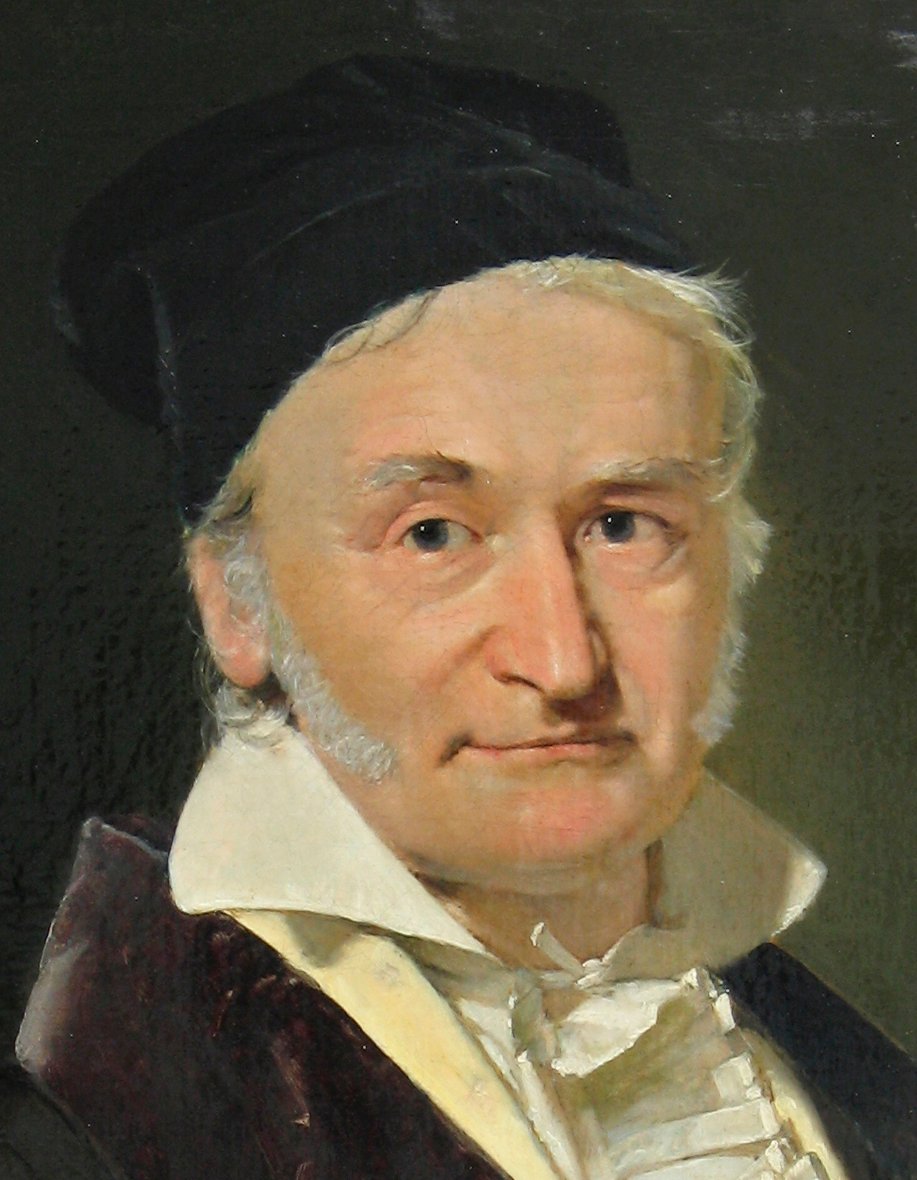
Carl Friedrich Gauss was born in 1777 in Brunswick, Germany, to a poor family, and showed extraordinary mathematical genius from childhood — the story of him correcting his teacher by instantly summing the numbers 1 to 100 using an ingenious method became one of the most famous anecdotes in the history of mathematics. He received support from the Duke of Brunswick that enabled him to pursue higher education.
In 1801 Gauss published «Disquisitiones Arithmeticae», which founded modern number theory. That same year, when the dwarf planet Ceres disappeared behind the sun after only a brief observation, Gauss developed a new mathematical method to calculate its orbit from a handful of observations, predicting its reappearance with astonishing accuracy that stunned astronomers of his time.
Scientific Legacy
Gauss contributed to countless fields: non-Euclidean geometry, statistics (the normal distribution, or «Gaussian curve»), linear algebra, and terrestrial magnetism. He served as director of the Göttingen Observatory for most of his career. He died in 1855, leaving a mathematical legacy considered among the deepest and most comprehensive ever produced by a single mind.