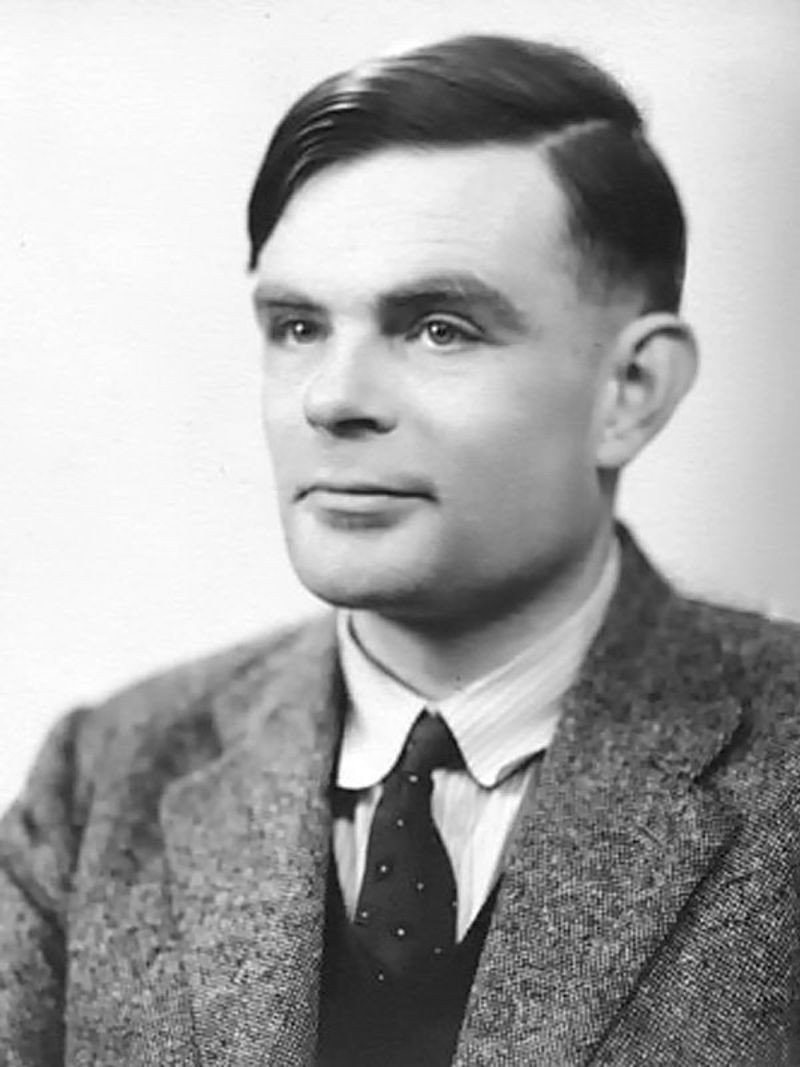
Alan Turing was born in 1912 in London and showed exceptional fascination with mathematics and logical puzzles from an early age. He studied at Cambridge and Princeton, and in 1936 published his landmark paper introducing the concept of the “Turing machine,” an abstract theoretical model that laid the mathematical foundation for the entire field of modern computing.
During World War II, Turing joined Britain's codebreaking team at Bletchley Park, where he led efforts to crack Germany's Enigma code by designing the electromechanical “Bombe” machine. Historians estimate this achievement shortened the war by roughly two years and saved millions of lives, though his work remained classified for decades afterward.
Father of artificial intelligence and theoretical computing
After the war, Turing continued his computing work, and in 1950 proposed the “Turing test” as a standard for evaluating a machine's ability to simulate human intelligence—a concept still central to artificial intelligence research today. Turing was persecuted for his homosexuality at a time when it was criminalized, and died in 1954 at age 41, decades before the British government issued a formal apology.
- Introduced the theoretical concept of the Turing machine
- Led the effort to crack the German Enigma code
- Proposed the Turing test for machine intelligence
- Laid the theoretical foundations of modern computer science