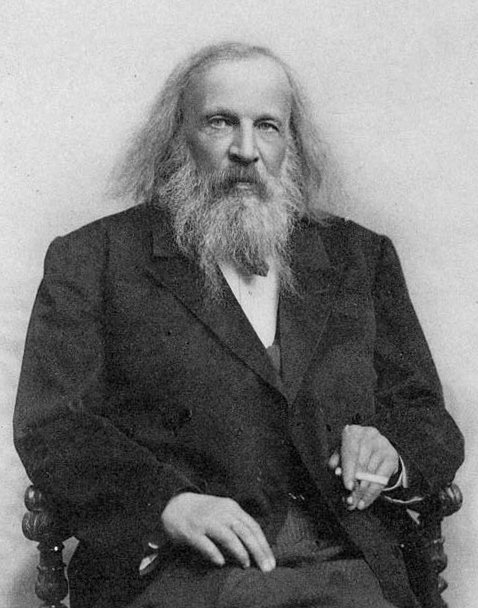
Dmitri Mendeleev was born in 1834 in Tobolsk, Siberia, the youngest of a large family. He studied chemistry in St. Petersburg and later in Europe, becoming a chemistry professor devoted to organizing the scattered chemical knowledge of his era.
In 1869, while writing a chemistry textbook, Mendeleev arranged the known chemical elements by atomic weight and recurring properties, creating the periodic table of elements. His work stood out for its boldness: he left gaps in the table, predicting the existence of undiscovered elements and forecasting their properties with striking accuracy—predictions later confirmed by the discoveries of gallium, germanium, and scandium.
An order underlying matter
The periodic table was far more than a classification list; it revealed a fundamental pattern governing the structure of matter and became an indispensable tool in chemistry teaching and research that endures today. In his honor, element 101 on the periodic table was named “mendelevium.”
- Created the periodic table of elements in 1869
- Predicted undiscovered elements and their properties
- Authored the influential textbook “Principles of Chemistry”
- Has the element mendelevium named in his honor